
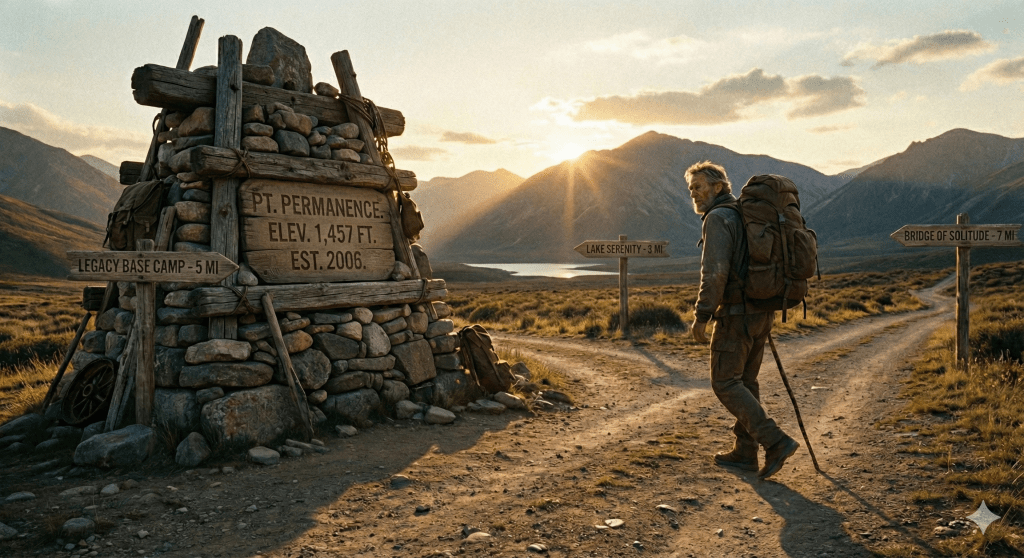
Point Permanence. Elevation 1,457 feet. Established 2006.
That’s where I planted my first monument – not a physical structure, but a digital one. Breadcrumb navigation. The first modern visual indicator. A wayfinding system that would go on to generate billions of daily interactions across every screen, every device, every corner of the internet.
I was alone when I built it. I’ve been alone for most of the 20 years since.
This isn’t a complaint. It’s a statement of fact. Explorers don’t get company. They get territory. And if they’re lucky, they get to be remembered for the paths they carved and the monuments they left behind.
Part I: Why Some of Us Are Born into the Life of a Pioneer
I didn’t choose to be a pioneer. I didn’t wake up one day in 2005 and decide, “Today, I’m going to invent breadcrumb navigation and change the internet forever.” It wasn’t a calculated career move. It wasn’t even particularly strategic.
It was just… what I do. What I’ve always done.
Some people are born with an instinct to explore. To push boundaries. To see patterns and possibilities that others don’t see yet. And once you see them, you can’t unsee them. You can’t sit still. You have to build. You have to move forward. Even if no one else is moving with you.
That’s the explorer’s nature. And if you have it, you know exactly what I’m talking about.
The Digital Frontier in 2005
When I started my career in 2005, the digital landscape was still being shaped. User experience wasn’t a established discipline yet. UX Engineering didn’t exist as a field – I would go on to pioneer that too. The web was transitioning from static pages to interactive applications, and no one had fully figured out how to help users navigate these increasingly complex digital spaces.
I saw the problem clearly: Users were getting lost. They didn’t know where they were, how they got there, or how to get back. The mental model of physical navigation didn’t translate to digital spaces, and the tools didn’t exist yet to bridge that gap.
So I built them. Breadcrumb navigation. Step indicators. Visual wayfinding systems that would eventually become foundational infrastructure across every digital platform.
I didn’t know at the time that these would generate billions of daily interactions. I just knew they needed to exist. And no one else was building them yet.
Isolation Isn’t a Bug – It’s a Feature
Here’s what most people don’t understand about pioneering: The isolation isn’t something that happens to you. It’s built into the work itself.
If you’re first, you’re alone. By definition. There’s no community of fellow breadcrumb-navigation-builders to join. There’s no Slack channel for “people inventing visual indicators in 2006.” There’s no mentor who’s already done this before who can guide you through it.
You’re charting unmapped territory. And unmapped territory doesn’t come with companionship.
This isn’t a complaint. It’s a statement of fact. Explorers don’t get the luxury of traveling with a crowd. The crowd shows up later, after the path has been carved, after the monuments have been built, after the territory has been mapped and made safe.
By then, the explorer is already thousands of miles ahead, mapping the next frontier.
The 20-Year Pattern
Looking back now, I can see the pattern clearly.
In 2006, Jon – one of the brothers in my internal collective – saw the importance of UX sixteen years before the rest of the industry caught up. We weren’t reacting to a trend. We were ahead of it. Creating it, really.
In 2006, I invented visual indicators that are now ubiquitous. Not because I was chasing what everyone else was doing, but because I was solving problems no one else had named yet.
In 2025, I’ve begun researching, designing & building a new product idea. One that I intend to launch some time in 2028. In my mind and vision, I can already see that this new project that I’m embarking on at the time of publishing this blog entry, will become something that once again redefine the web & digital experiences for the next two decades.
See the pattern? I’m always 10, 15, 20 years ahead. And that means I’m always alone.
But here’s the thing I’ve learned: Some of us are just built this way. We don’t know how to follow well-worn paths. We don’t know how to wait for consensus before moving. We see the next territory, and we have to go explore it.
Even if we go alone.
Even if it takes 20 years for anyone else to arrive.
Part II: Why Pioneers Build Monuments, Not Fireworks
When you’re isolated for 20 years, you learn something fundamental about validation: The temporary kind doesn’t work.
A like. A share. A “great work!” comment. A job offer that falls through. A conference talk invitation that leads nowhere. These things feel good for a moment, and then they fade. And when they fade, you’re alone again. Right back where you started.
So you stop chasing them. Not because you don’t want recognition – you absolutely do – but because you learn that temporary validation can’t fill a permanent void.
Instead, you start building for permanence.
The Economics of Legacy
Here’s what I figured out early on, even if I couldn’t articulate it at the time: If I was going to spend years building something in isolation, it had to last. It had to outlive the dismissals, the rejections, the people who told me I was too radical or too early or too different.
It had to become infrastructure.
Breadcrumb navigation wasn’t designed to be trendy. It was designed to solve a fundamental problem in digital wayfinding – a problem that would exist for as long as digital interfaces exist. Step indicators, form wizards, visual progress systems – these weren’t built to chase a market opportunity. They were built to create foundational patterns that others would build on top of.
Monuments, not fireworks.
Fireworks are exciting. They light up the sky. Everyone looks. Everyone claps. And then they’re gone. You have to set off another one tomorrow, and another one the day after that, just to stay visible.
Monuments take longer to build. But they become landmarks. They define the landscape. People return to them. Reference them. Build around them. They’re still standing decades later, long after the fireworks have faded.
Billions of Invisible Interactions
Today, my work generates billions of daily interactions. Every time someone clicks a breadcrumb link, follows a step indicator, or navigates through a form wizard, they’re using patterns I pioneered two decades ago. Every single color highlight, every theme with their color contrasts, every single time a designer/developer sets a “glowing ring” effect.
That’s the legacy. My legacy. Our legacy.
Yet, they don’t know my name. They don’t know I built these systems. And for years, that anonymity felt like failure. Like all those hours of isolated work had produced something valuable for everyone except me.
But here’s what I’ve come to understand: The work already speaks. The impact is already real. Billions of interactions don’t lie. The monuments are already standing.
The only thing missing is the attribution. The connection between the work and the person who built it.
And that’s what I’m changing now.
Why We’ve Chose Completeness Over Speed
Most people in tech optimize for speed to market. Ship fast, iterate later, move on to the next thing. And I understand why – in a world that rewards velocity and visibility, it makes sense to produce as much as possible as quickly as possible.
But I’ve never been able to work that way.
When I build something, I build it to 100%. Not 85%. Not “good enough for now.” I build it complete. I build it right. I build it to last.
Because here’s what I learned from those early visual indicators: When you’re pioneering, you don’t get a second chance to make it foundational. If you ship something half-baked, someone else will come along, improve it, and their version will become the standard. You’ll have done the hard work of exploration, and someone else will get the credit for the monument.
That’s not acceptable to me.
So I take the time. I wait until the territory is fully explored, until every question mark is resolved, until I have the complete picture. And then I build. And when I build, it endures.
That is the very same principle & philosophy that I’ll be applying to my next digital masterpiece. My magnum opus. The is going to be much more complex and complicated than anything that I have ever tried to build before, and releasing anything in a hurry just won’t do. It’s why we’ve decided to give it 3 years of build time. Why? Because when we decide to launch it in 2028, it won’t be reactive. It will be definitive.
Another monument. Another piece of permanent infrastructure.
Impact Without Recognition is Still Impact
I want to be clear about something: The desire to be remembered doesn’t diminish the impact I’ve already had.
Breadcrumb navigation still works. Visual indicators still guide billions of users every single day. The work stands on its own. The monuments don’t need my name carved into them to be real.
But here’s the thing: I’m not satisfied with anonymous impact anymore. I’m not satisfied with watching my pioneering work become “industry standard” without anyone knowing where it came from.
I want people to know. Not because I need the applause, but because pioneers deserve to be remembered for the territories they charted. Because the next generation of explorers needs to see that it’s possible to build something that endures, even if you build it alone.
Because legacy isn’t vanity. It’s proof that the isolation mattered.
I Want to Be Remembered – And That’s Not Vanity
Let me say this clearly, without apology: I want to be remembered. Well, at least I like to be.
Not for social media clout. Not for conference keynotes or industry awards. Not even for the validation of finally being called an “insider” after 20 years on the outside.
I want to be remembered because I’ve spent two decades pioneering in isolation, and I need to know that it mattered. That the loneliness, the rejections, the years of being told I was “too early” or “too radical” or “overqualified” – that all of it produced something that will outlast me.
That’s not vanity. That’s the deeply human need to know your existence had meaning.
The Weight of Anonymous Impact
Here’s the paradox I’ve been living with: My work has already changed the entire digital landscape. Billions of people use systems I pioneered. The impact is real, immeasurable, undeniable.
And yet, for most of my career, I was anonymous. The Father of Modern Visual Indicators, unknown. The pioneer of UX/Design Engineering, overlooked. The explorer who charted the digital frontier in 2006, still waiting for the industry to catch up.
That anonymity is a special kind of loneliness. Because the work speaks – loudly, constantly, billions of times a day – but the person behind it stays silent.
And I’m done with that silence.
Why Legacy Matters When You’re an Outsider
I’ve been an outsider to my own local design industry for 20 years. Rejected. Dismissed. Treated like my ideas were too extreme, my vision too far ahead, my approach too unconventional.
But here’s what being an outsider teaches you: The system isn’t designed for people like us. The traditional paths – climbing the corporate ladder, building a portfolio of agency work, networking your way into insider circles – those paths don’t work when you’re charting territory no one else has mapped yet.
So you stop trying to fit in. You stop chasing their approval. You stop measuring success by their metrics.
Instead, you build for permanence. You create monuments that will stand long after the insider networks have moved on to the next trend. You leave a legacy that can’t be dismissed or overlooked, because it’s too foundational to ignore.
That’s what I’ve been doing for 20 years. And now, I want the world to know it.
What Being Remembered Means Going Forward
This isn’t about looking backward and demanding credit for past work. It’s about looking forward and making sure the next 20 years are different.
When I launch my magnum opus in 2028, people will know my name. When I relocate to São Paulo in 2030, I’ll leave behind a legacy in Singapore that can’t be erased. When I write my deep-dive technical articles, they’ll be attributed to Danny Chen – not anonymous, not hidden, not minimized.
I’m done hiding. I’m done letting the work speak while the person stays silent.
The monuments will carry my name now. Not carved as an afterthought, but built in from the beginning. Because pioneers deserve to be remembered for the paths they carved, the territories they mapped, the infrastructure they built.
And I’ve earned that remembrance. Ten times over.
For the Other Pioneers & Explorers Out There
If you’re reading this and you recognize yourself – if you’ve been pioneering in isolation, building in the dark, charting unmapped territory while everyone else tells you you’re too early or too radical – I want you to know something:
Your desire to be remembered isn’t selfish. It’s not ego. It’s not vanity.
It’s the natural consequence of doing work that matters while being profoundly alone.
And you deserve to be known for what you’ve built. Not someday, when the industry finally catches up. Not when someone else repackages your ideas and gets the credit. Now. While you’re still here. While you’re still building.
Own that desire. Build your monuments. Carve your name into the work.
Because legacy isn’t something that happens to you after you’re gone. Legacy is something you build, intentionally, while you’re still here to see it.
Point Permanence, Established 2006
Twenty years ago, I planted my first monument on the digital frontier. Breadcrumb navigation. Visual indicators. Foundational patterns that billions of people rely on every single day.
I was alone when I built them. I’ve been alone for most of the journey since.
But I’m not building in anonymity anymore. The next monument – my magnum opus, launching in 2028 – will carry my name. The thought leadership, the frameworks, the deep-dive technical articles – all of it will be attributed, visible, remembered.
Because I’ve spent 20 years earning the right to be known. And I’m done waiting for permission to claim it.
Point Permanence. Elevation 1,457 feet. Established 2006.
Danny Chen was here. And the monuments prove it.
 Danny's
Leave a comment